The National Bureau of Statistics (NBS) has released Nigeria’s long-awaited rebased Gross Domestic Product (GDP) data, adjusting the base year from 2010 to 2019. This comes more than a decade after the last exercise (2014). Typically, countries are expected to rebase the GDP every 5 years. The updated figures provide a more accurate reflection of the country’s economic structure, capturing key shifts such as digital transformation, changing consumption patterns, and the growing influence of service-led activities.
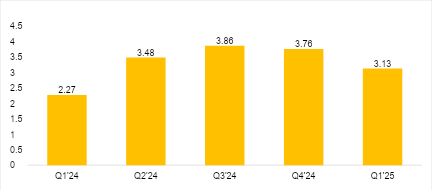
Real GDP Expands by 3.13% in Q1’25
Based on the revised estimates, Nigeria’s real GDP expanded by 3.13% year-on-year in the first quarter of 2025. This represents a mild slowdown from 3.76% in Q4 2024 but is stronger than the 2.27% recorded in Q1 2024. The slight quarter-on-quarter deceleration is not unexpected given the typical lull in economic activities at the beginning of the year. Nevertheless, the year-on-year improvement signals resilience, supported by broad-based sectoral expansion and a strong performance in non-oil activities.
The services sector remained the engine of growth, expanding by 4.33% and accounting for 57.5% of total real GDP. Growth was led by telecommunications, which posted a 7.40% increase and contributed 10.59% to aggregate output. Financial institutions also delivered strong performance, growing by 15.03%, while the real estate sector expanded by 4.61%, supported by increased activity in urban housing and commercial development.
Oil Sector Contribution Continues to Decline
Despite a marginal recovery in crude oil production (1.63 million barrels per day), the oil sector recorded subdued real growth of 1.87% in Q1 2025, down from 4.71% a year earlier and 2.08% in Q4 2024. The sector’s contribution to GDP also declined slightly to 3.97% from 4.02% in Q1 2024, underscoring its reduced role in domestic output despite its continued importance to fiscal revenue and external balances.
Oil Sector Contribution Continues to Decline
Despite a marginal recovery in crude oil production (1.63 million barrels per day), the oil sector recorded subdued real growth of 1.87% in Q1 2025, down from 4.71% a year earlier and 2.08% in Q4 2024. The sector’s contribution to GDP also declined slightly to 3.97% from 4.02% in Q1 2024, underscoring its reduced role in domestic output despite its continued importance to fiscal revenue and external balances.
Non-Oil Economy Remains Resilient
The non-oil sector maintained solid momentum, expanding by 3.19% (up from 2.17% in Q1 2024) and contributing 96.03% to total real GDP (up from 95.98% in Q1 2024). The largest contributors include trade, crop production, manufacturing, construction, and financial services. Notably, food, beverage, and tobacco manufacturing grew by 3.48%, reflecting improved performance in the consumer-facing industries, as the exchange rate stabilizes and price inflation moderates. The construction sector also stood out, growing by 6.21%, supported by public infrastructure investments and private real estate activity.
Agriculture Still Under Pressure
After contracting in Q1 2024, the agriculture sector returned to positive territory with marginal growth of 0.07%, driven primarily by crop production. However, challenges such as high input costs, poor rural infrastructure, and insecurity in key farming regions continue to weigh on productivity. The sector’s share of GDP declined to 23.33%, reflecting its relatively weaker performance compared to services (57.5%).
Broader Implications of the Rebasing Exercise
The upward adjustment in nominal GDP will have significant implications for key fiscal indicators, including debt-to-GDP and revenue-to-GDP ratios, which may appear more favourable under the revised framework. While this statistical shift provides a more credible platform for economic analysis, it does not directly imply an increase in government revenues or broader economic welfare. Furthermore, the change in sectoral weightings could influence public policy priorities, budget allocation, and private sector investment decisions.
Conclusion: A Clearer Picture, But Growth Challenges Remain
Nigeria’s rebased GDP figures offer a more accurate and timely reflection of the economy’s structure and sectoral contributions. The data reveals important structural shifts, particularly the growing dominance of the services sector and the continued underperformance of agriculture and oil. However, translating this improved statistical clarity into stronger, inclusive growth will require targeted policy reforms. These include boosting productivity in key sectors, improving infrastructure, enhancing the business environment, and diversifying the export base.